Why Your First Lines Should Be Wrong
A drawing is not a record of certainty. It is a process of discovery.


I have a big lesson for you today.
Here is something I notice often in my drawing classes: the first lines in the drawing never change. There is something about drawing which seems to suggest that you need to look in front of you, see what’s there, and then commit it to paper. And once it’s on paper, it cannot be changed.
I recently taught a course that alternated between clay modelling and drawing, focused on the portrait. At the end, I asked students if it had been easier to draw or to model. They said it was easier to model, and one student explained that with clay she could see what needed changing and simply grab that part and move it. But in drawing, she felt she couldn’t do that.
Look at the drawings above. There is a sense of movement and searching in both. There are lines that are repeated, as if the artist was feeling for the right line or the right placement. Rather than certainty, these drawings express a kind of doubt or questioning. Both artists were concerned with expressing physicality and the difficulty of determining their subject’s boundaries in space. They used drawing as a method to figure out problems that they ultimately expressed in other media: Cézanne in paint, Giacometti in clay.
These repeated lines are not signs of failure or indecision. They are evidence of looking.
What I am getting at here is that drawing is always a process of trying to figure something out, rather than moving toward a predetermined shape. If you think that you can look at your subject, “get it,” and then simply render it on the page, then you have already reached a conclusion before drawing anything at all. And whatever lines you put down will never change because you will not see how they are wrong.
Instead, I invite you to recognize that you do not fully know what you are looking at and to use drawing as a method to try and make sense of what is out there.
In other words, whatever you’re drawing, do not draw that.
If you’re drawing a portrait, do not draw eyes, nose, mouth. If you’re drawing a figure, do not draw face and hands and fingers and nipples.
Drawing is about relationships, not details.
Beginners often think drawing is about identifying things. But drawing is really about relationships: angle, size, direction, pressure, proportion, light, shadow, negative space.
This means that you need to spend most of your time articulating the framework of shapes that forms everything you can see. Make a map of the areas of light, shadow, and negative space. Assess the relative size of these shapes and the spaces between them. Once these larger relationships are satisfactory, you can begin breaking them into smaller shapes. Slowly, your drawing can start to look like what it is depicting in a more convincing and structured way.
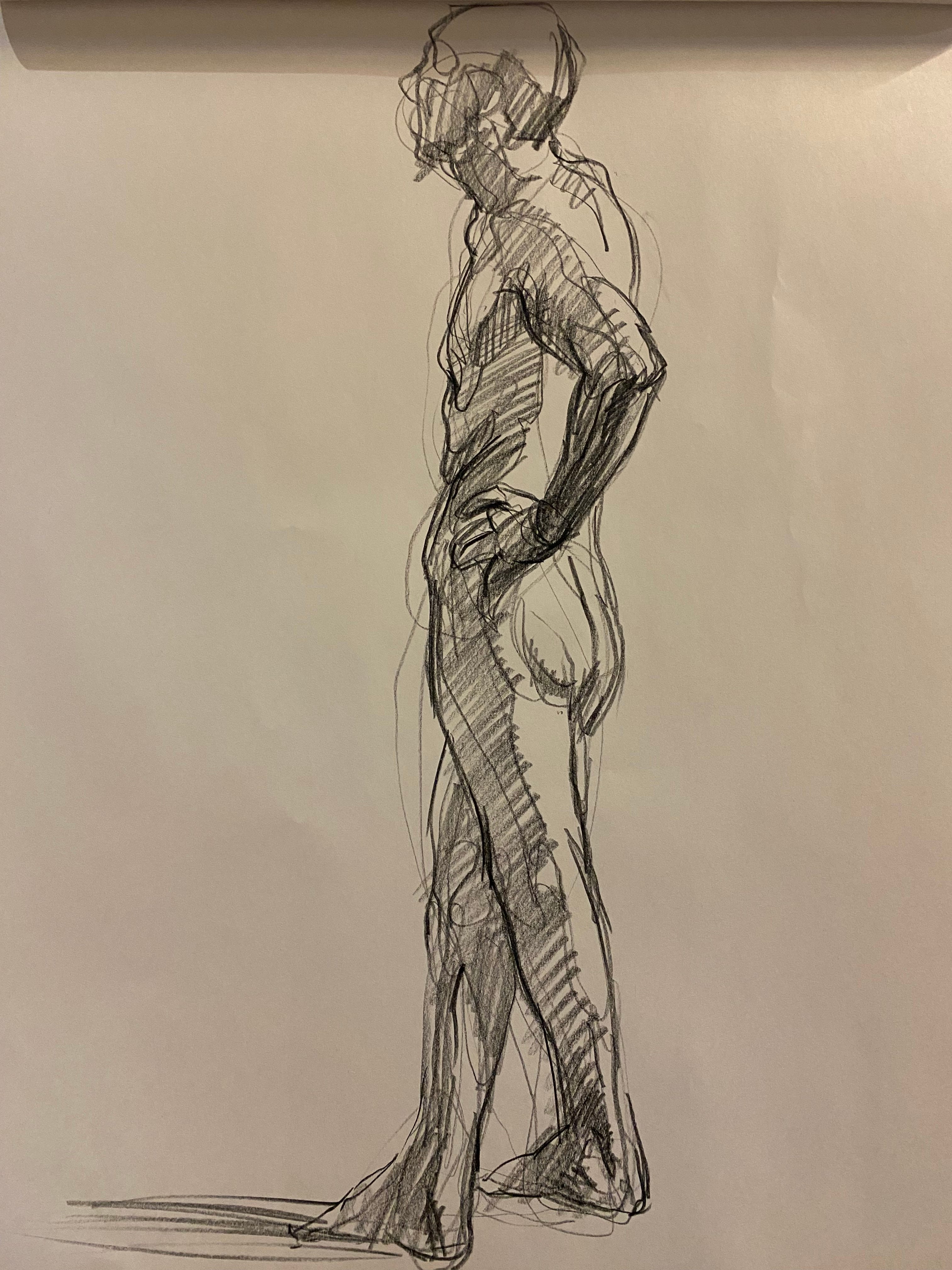
Now here are two drawings that I made. Let’s look at my process. You can also see the recordings at the end of the article.
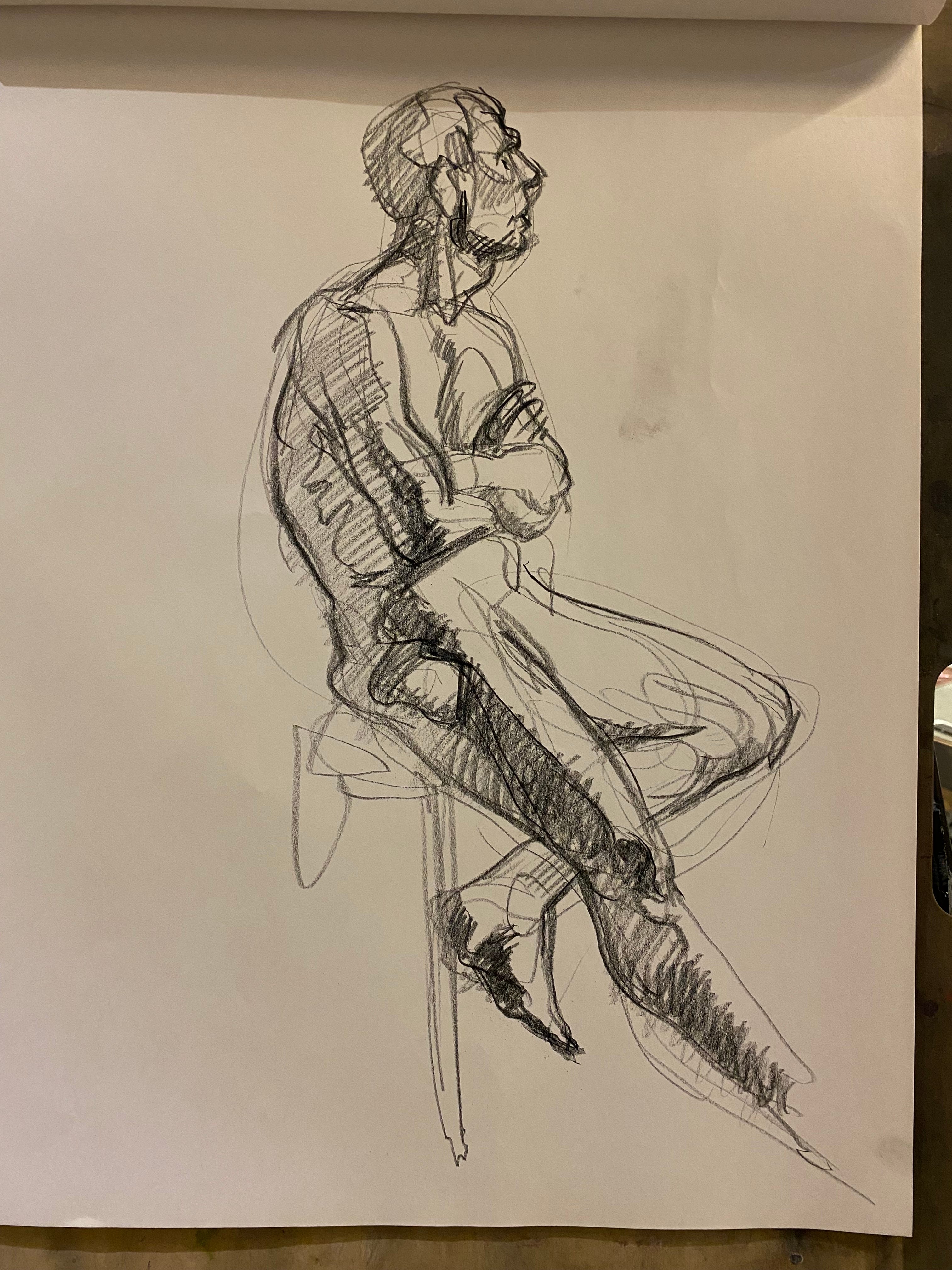
I like to begin with a loose, light continuous-line approach. I take my time to feel my way into a general shape and to loosely establish how big the drawing will be on the page. I expect this early line work to need adjustment because I don’t yet know what I am looking at.
Be conscious of anything that you notice first in your subject and account for that early on. In the first drawing, I noticed how rounded the back was and contrasted that curve with the squareness of the crossed arms in front. Just simple shapes with roughly correct sizes. The legs formed a figure four, so that became another major shape that I related to the torso.
Strong shadows are extremely important for convincing drawing, and this pose had them. I drew a simplified shape describing the entire shadow area of the back, arm, and leg. This helped connect the first major forms together. I placed a rough shape for the head and everything was already beginning to relate.
Another important concept is that you should avoid finishing any one part too early and instead develop the drawing evenly. This means constantly moving around the drawing. I like to refer to this as “doing tours.” Every time you go around the figure, you reassess relationships, adjust if necessary, or break larger shapes into smaller ones.
The drawing develops gradually through these repeated passes. Not through certainty, but through looking.
This approach works really well for portraits as well. But again, you must forget about drawing eyes, nose, mouth.
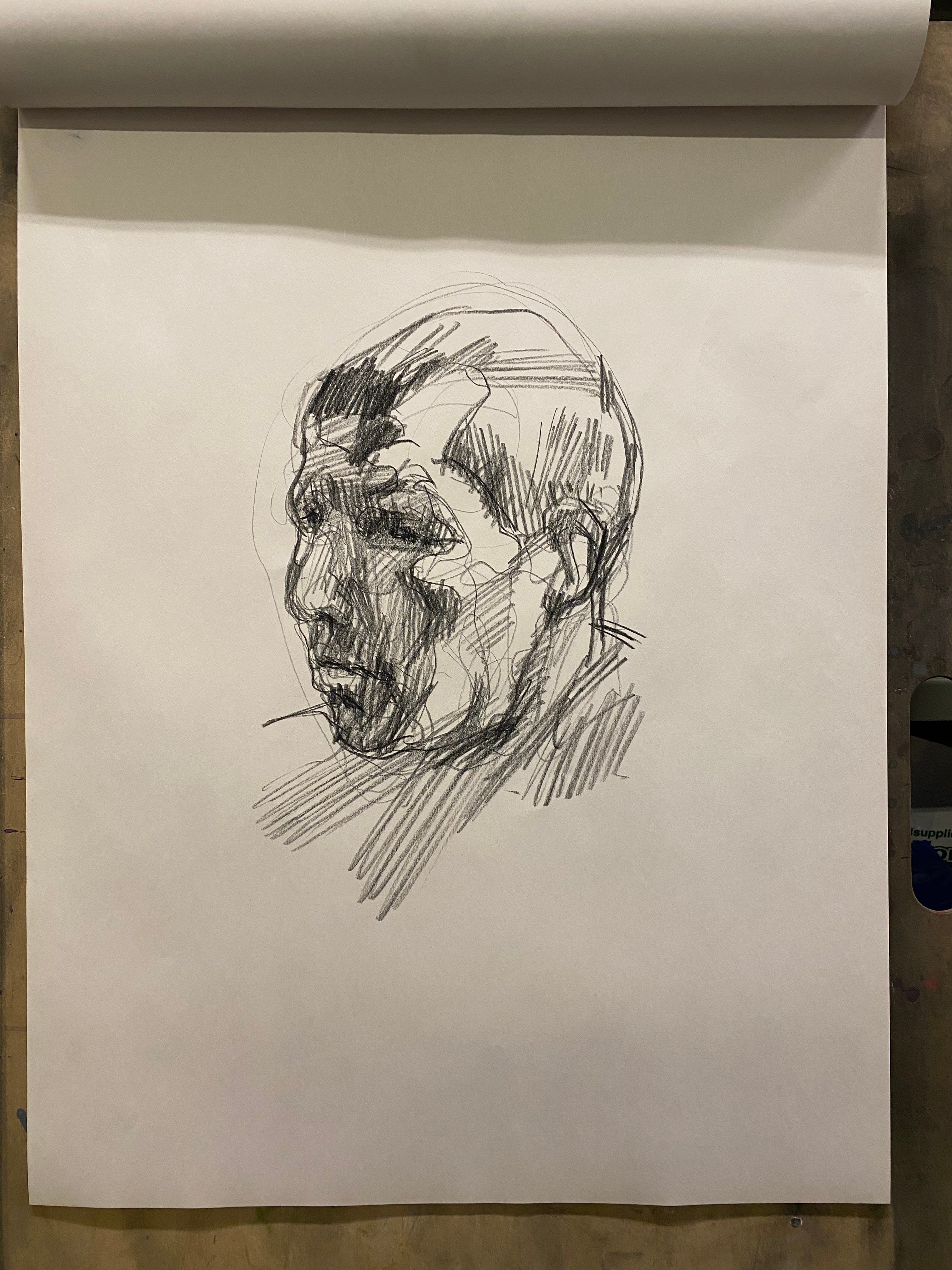
The next stage is to loosely fill in the shadow areas. This makes it easier to visualize them and quickly gives the drawing a strong sense of three-dimensional form. I also like to use directional hatching, running lines in different directions that match the varied orientation of the surfaces being depicted. Look at the forehead versus the brow ridge, eye sockets, nose, and cheek.
If you’ve gotten this far, then most of the battle is already won. The structure, resemblance, and form are already there. All that remains is to break things down into smaller shapes, introduce more values, more information, more detail. Only then can it begin to look like whatever it is.
The actual process of searching, adjusting, and “doing tours” is much easier to understand when you can watch it unfold in real time.
I recorded both drawings from start to finish so that paid subscribers can follow how the relationships gradually develop, shift, collapse, and reorganize over time.
Have a look at the recordings and try it for yourself. Let me know how it goes.
I would turn the sound off because it’s just ambient noise. You could also speed these up a bit, it’s interesting to see them happen faster. Try to notice that I am always moving lines, redrawing, revisiting, adjusting, all the way to the end. This is essential if you want to move towards precision while keeping the drawing alive.
Here’s a bonus third demo, I really had fun making these drawings today!